


 IT
IT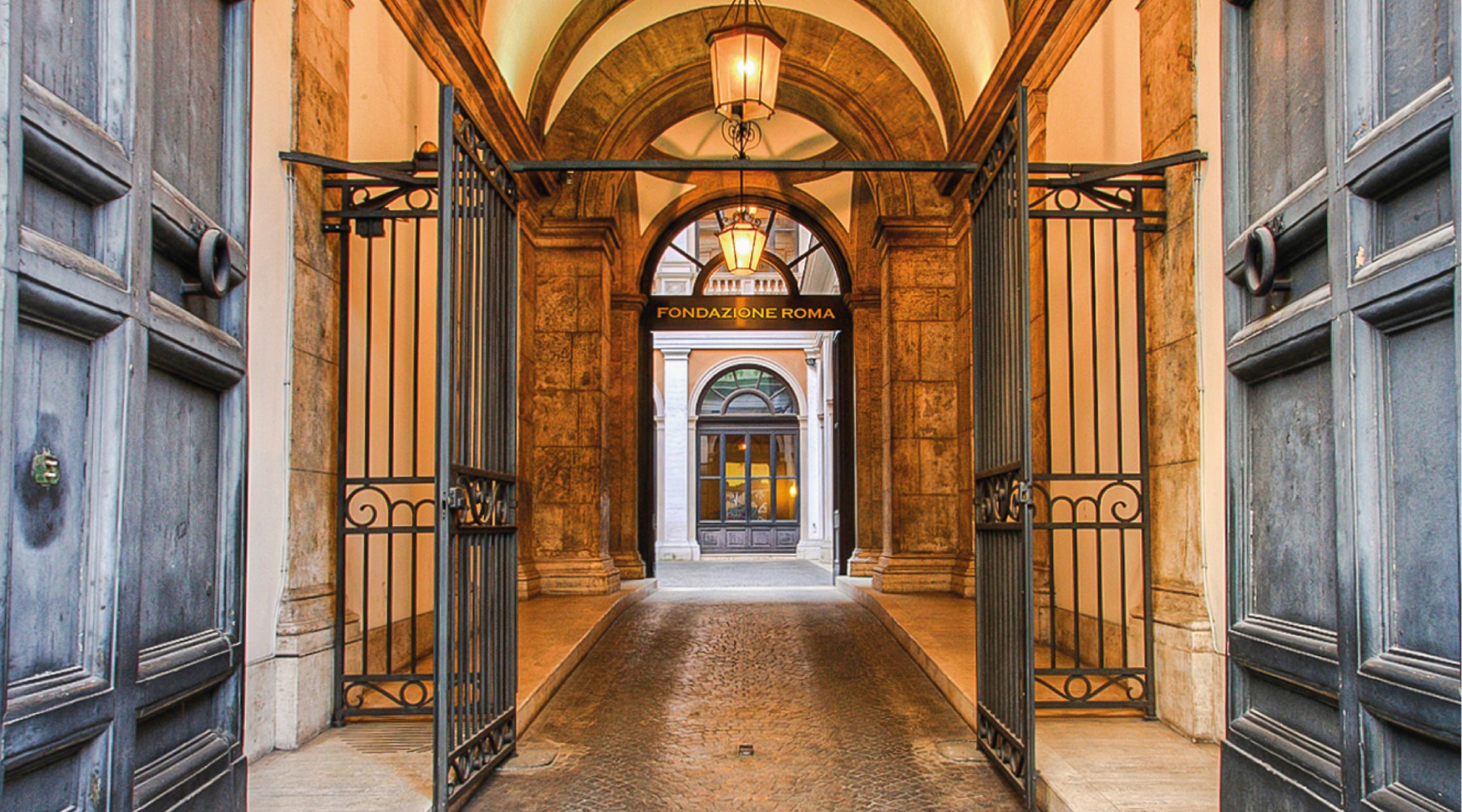
Fondazione Roma is headquartered in the historic building of Palazzo Sciarra Colonna, which overlooks Via del Corso, in the heart of the city.
Here, from the early centuries of Christianity, some of the oldest sacred buildings emerged, and from the 15th century onwards, important patrician residences were built. Its construction was promoted in the second half of the sixteenth century by the Sciarra family, a branch of the Colonna family that held the principality of Carbognano, on the site where the Colonna family owned two distinct building complexes: the “palazzo imperfetto” (unfinished palace) and the “palazzetto” (small palace), for which in 1610 the Milanese architect Flaminio Ponzio designed the unification.
In 1641, Orazio Torriani took over the construction site, author of the noble and severe façade, framed by rusticated corner stones, crowned by a corbelled cornice and marked by three orders of windows.
The monumental entrance is characterized by a rusticated arch, in front of which, placed on high plinths, stand two fluted columns with composite capitals, supporting the balustraded balcony of the first floor. The front of the plinths and the balustrade are enriched by columns carved in relief, as a reminder of the Sciarra family’s origin from the prestigious Colonna family.
The palace, precisely for the beauty of its portal, was included among “the four wonders of Rome”, together with the Borghese harpsichord, the Farnese die, and the Caetani staircase.
In the eighteenth century, Cardinal Prospero Colonna promoted the adaptation of the palace to the style of the era. Architect Luigi Vanvitelli, a friend of the Cardinal, also participated in the architectural and pictorial renovation, designing its restructuring.
The Domestic Library, the Small Gallery, the Mirror Cabinet, rich in pictorial decorations, are some of the rooms born from these interventions, which increased the historical and artistic value of the palace.
At the end of the nineteenth century, Francesco Settimi took care of the restoration of the surrounding buildings, the expansion of the right wing of the building, and the reconstruction of the courtyard.
The palace was considerably reduced in size between 1871 and 1898, when Prince Maffeo Sciarra entrusted Giulio de Angelis with the opening of the adjacent Via Minghetti, the construction of the palace block, the Quirino theater, and the Galleria Sciarra behind it.
PERMANENT COLLECTION
The Art Collection of Fondazione Roma consists of a substantial and original corpus of works ranging from the fifteenth century to the present day.
Based on a modest original nucleus from the collections of the Monte di Pietà and the Cassa di Risparmio di Roma, it has been significantly increased over the years through an acquisition programme designed to build and make the Collection accessible to the public in a permanent exhibition space, specifically created at Palazzo Sciarra Colonna.
Unlike other private artistic collections belonging to Roman galleries, kept intact over the centuries, the Art Collection of Fondazione Roma is characterized by this careful series of acquisitions that continue to increase the original nucleus.
The Collection focuses mainly on artists working in Rome. The central nucleus of the Collection consists of works belonging to late-baroque and Marattesque culture, establishing itself in the Roman museum panorama as one of the most representative picture galleries of Roman figurative culture between the seventeenth and eighteenth centuries.
Later centuries are also well represented, extending to major contemporary artists who have maintained various ties with the capital. The exhibition is further enriched by a selection of four hundred items from Fondazione Roma’s valuable numismatic heritage, drawn from a collection of over two thousand five hundred medals and coins. The most substantial component is the series of papal medals, ranging from Martin V Colonna to Pope Francis.
Reflecting six centuries of papal history, this numismatic collection may be considered, in terms of both the number and quality of its specimens, second only to the Medal Collection of the Vatican Apostolic Library.
HISTORICAL ARCHIVE
In 2010, Fondazione Roma acquired from UniCredit S.p.A. the archival collections relating to the Sacred Monte della Pietà of Rome and the Cassa di Risparmio di Roma. The purpose is the preservation of a historical memory that enhances the charitable spirit, to which the roots of the Foundation can be traced.
This is a complex and heterogeneous documentary system, accumulated between the 16th and 20th centuries and preserved within Palazzo Sciarra Colonna.
On the ground floor of the Palace, an exhibition space has been set up to offer a historical overview that begins with the founding bull of the Sacred Monte della Pietà, up to the minutes that decreed the merger of both credit institutions in 1937.
A significant documentary heritage that contributes to greater knowledge of the origins and history of both entities. Users can access the Historical Archive by appointment and authorization, issued by the Archival Superintendent for Lazio.